
Audiences are fed up with the sensationalism and negativity bias of the news — but the media can still correct course and in turn better serve our democracies.
Constructive journalism is an editorial approach that goes beyond reporting with the “if it bleeds, it leads” culture so that audiences get the full story, not just half the picture. The Three Pillars – solutions, nuance and democratic conversation – are the foundation of constructive journalism practice.
Why we need constructive journalism
Constructive journalism is a response to the increasing sensationalism and negativity bias of the news media today. Its main mission is to reinstall trust in the idea that shared facts, shared knowledge and shared discussions are the pillars on which our communities depend – centering the democratic function of journalism as a feedback mechanism that helps society self-correct.
The internet and consequent digital disruption has had seismic impacts on the news industry. Not only have business models for journalism been shaken and competition for the attention of news audiences exacerbated, but news has also sped up, increased in volume, and become increasingly sensationalist. Traditional news reporting is often biased toward negativity and cynicism, neglecting to contextualize the news of the day with relevant context and research.
This imbalance leads people to grossly overestimate the negative and underestimate progress. Surveys across the world show that what the public believes about their countries is often far from the truth. Life is better than they think. People rate the performance of their societies much more poorly than reality. This has consequences for how people live, vote, and treat one another.
Political polarization has also fueled the growth of partisan agendas online, which – together with clickbait, algorithms feeding on outrage, and various forms of misinformation – further undermines trust in the media and raises new questions – raising new questions about how to deliver balanced and fair reporting in the digital age. Business as usual is no longer an option for news organizations.
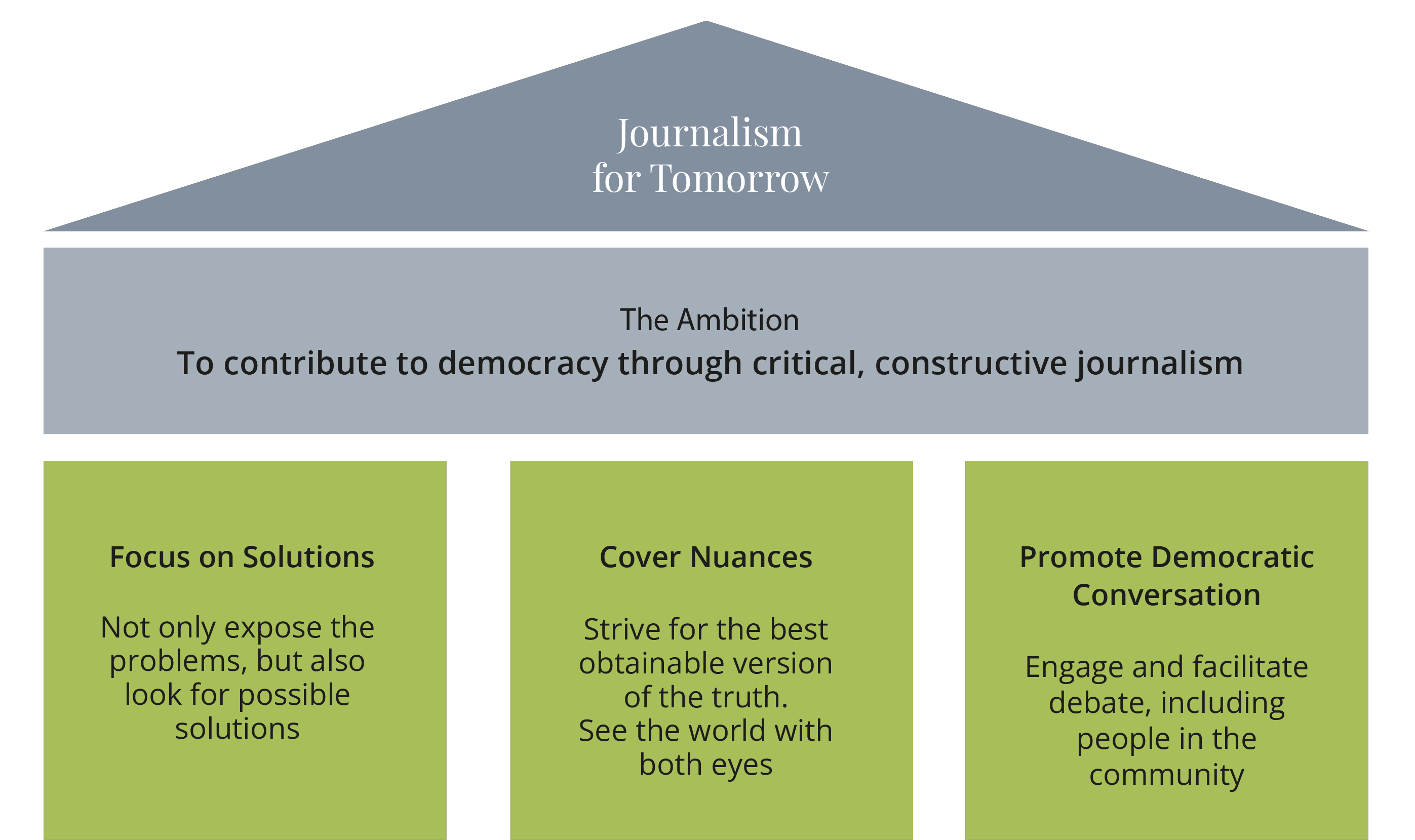
That’s why we came up with constructive journalism. It is not positive, uncritical news, an alternative to watchdog reporting, or a quick fix to the media industry’s problems. Instead, it acknowledges that in order to serve democracy, quality reporting must be critical, inspirational, nuanced, and engaging.
Constructive journalism introduces a new vocabulary, enabling both journalists and the audiences they serve to have a better conversation – not only about what is missing in traditional reporting but also about how we can improve it with new questions, new focus, new roles, new concepts, and new tools. Read more about the trust meltdown in our societies, and how constructive journalism can help, from Constructive Institute founder Ulrik Haagerup.
How it works
In practice, constructive journalism focuses on important societal issues, placing them in a broader perspective and in their relevant context. It serves as an additional layer to both breaking and investigative journalism, and it rejects the “if it bleeds, it leads” approach of traditional news coverage.
After fulfilling the role of policeman – documenting evidence – and then the role of judge – investigating evidence and pronouncing judgment – the constructive journalist takes on the role of a facilitator, seeking ways beyond the problem. It is a shift that looks to the future and aims to leave the news audience inspired, hopeful, and motivated.
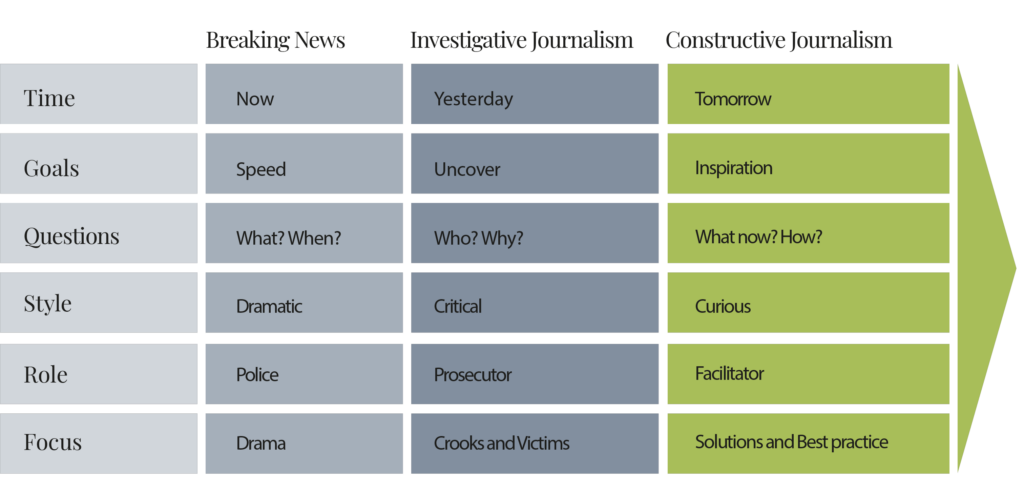
The culture shift impacts every step of the workflow of the newsroom:
Constructive journalists covering politics, for example, focus less on horse-race election coverage – who’s up and who’s down in polls or fundraising – and more on the details voters need to make informed decisions about at the ballot box. This approach steers politicians away from partisan talking points and toward concrete proposals that address society’s most pressing challenges.
The Three Pillars of constructive journalism
Focus on solutions
Constructive journalism is rigorous and critical in its approach – both when reporting on problems and progress. It highlights responses to well-documented problems, changing the focus of the story from the problem itself to the efforts to solve it.
The aim of constructive journalism is not activism. It does not focus on “feel-good” stories or view the world through rose-tinted glasses. Instead, its goal is to rigorously report on potential solutions to important social issues.

How To Incorporate Solution-Focused Stories into Radio Newscasts
Newsroom: NDR (Germany)
Cover nuances
In many ways, constructive journalism returns reporting back to its core values – balanced, fair, and non-sensational. This approach is calm in tone, with less emphasis on tabloid-style scandals, conflicts, and outrage.
Ultimately, the goal is to help the public develop an accurate understanding of the world, rather than a simplistic one. Instead of portraying issues in black and white, constructive journalism embraces complexity – trusting that audiences value a complete, nuanced narrative over a simplified version.

How To Embrace Nuance in Political Coverage
Newsroom: Berlingske (Denmark)
Promote democratic conversation
This pillar seeks to strengthen democracy and counter political polarization by promoting civil discourse, engaging audiences, and building trust in the media. Its purpose is not to exacerbate problems, ignite conflict, or take sides on divisive issues, but to enable critical but constructive debate about potential solutions so progress can be made.
An example we love: ZEIT ONLINE’s My Country Talks project, which has paired more than 200,000 individuals with opposing political views for one-on-one discussions aimed at bridging social and political divides.

How To Host A Civil And Curious Political Debate Show
Newsroom: NRK (Norway)
We collaborate closely with organizations committed to revitalizing the news media. Related approaches include solutions journalism, which emphasizes the first of our Three Pillars, and dialogue journalism, which centers on journalists’ effort to engage audiences, promote civil discourse, and increase trust in the media.